About the W123 240D
The W123 Series is one of the most successful and beloved models in Mercedes-Benz history. It was the midrange model in the lineup from late 1976 to 1985. Today this place is occupied my the E-Class. The W123 series has a reputation of impeccable engineering and incredible longevity. If there was any model that epitomises that, it was the 240D. Of the almost 2.7M W123s made, almost 450,000 of them were 240Ds. It is fitting that the 240D is type 123.123.
In Europe the 240D was the taxi of choice. More powerful and usable than the 200D or 220D, and with almost no fuel penalty. In other parts of the world it was an entry level Mercedes-Benz with rugged simplicity.
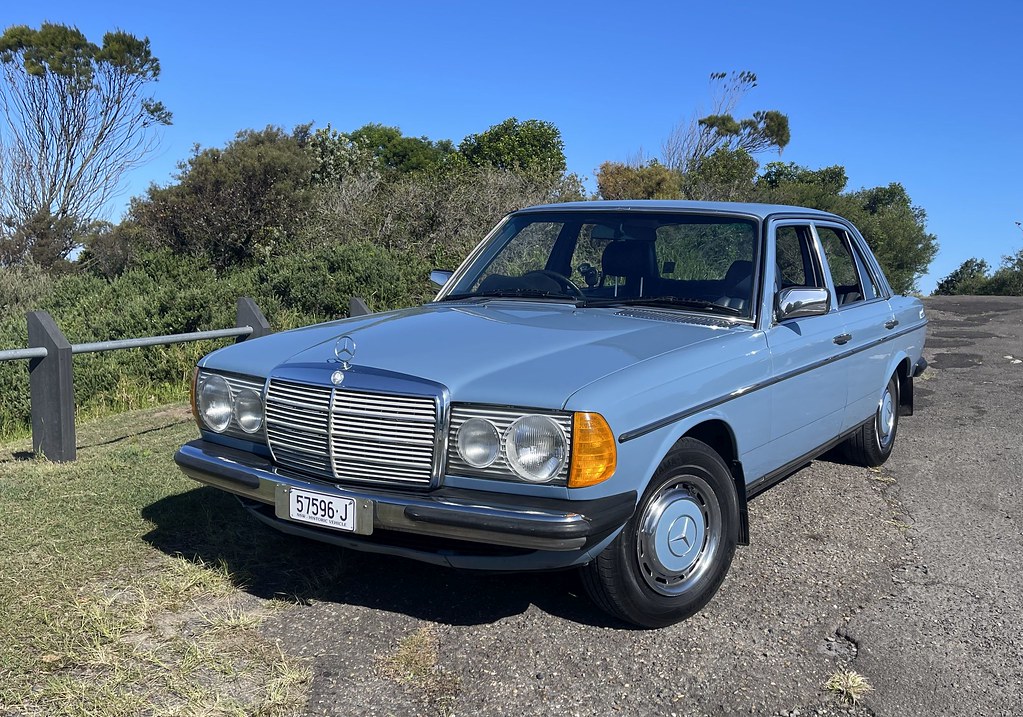
In Australia it had more of a niche role in the lineup. It was never a huge seller and appealed mostly to value oriented country buyers who valued its impeccable engineering as well as low running cost over big mileages. While it was a very expensive car, it would last far longer than anything else you could buy, so in the long term it was quite good value.
The 240D was launched in Australia with the rest of the W123 range in November 1976. However, it was discontinued by June of 1978. This was the original version with 64hp, and was offered with an automatic transmission. In June of 1980 the 240D was reintroduced with the option of a manual transmission as well as the automatic. This was now the updated version with 71hp. The 240D would continue until the end of 1982 when it was discontinued again. My guess is that the advent of the 230E killed demand. Diesel buyers still had the 300D and the 230E was no more expensive and so much better than the old 230 carby.
Today there are few left. There is not a single one historically registered by the Mercedes-Benz club of NSW (at 4/24). Never a big seller to begin with, the 240D was far less popular on the used car market. Once the cars dropped down in price, buyers wanted the 280E, 230E and 300D. The 240D suffered due to the reputation of it being dangerously slow with an automatic transmission. While the 240D is not a fast car by any means, this reputation was unfair. Lack of maintenance on the vacuum system would cause the transmissions to shift into top gear far too early, and the cars would bog down and be unable to accelerate. Maintained properly, the automatic is not nearly as slow as most think.
There were two other factors in the demise of the 240D in Australia. The first was the aftermarket turbo kits that were popular in the 80s. Even some dealers apparently offered them. Stuttgart would have been horrified. While the OM615/616 and 617 engines are rugged and long lived, they did not respond well to turbocharging. The 617A offered in the USA was a highly modified engine from its natural aspirated cousin. The naturally aspirated engines did not last long with this kit. The kits were quite popular, and at one point they were regularly advertised for sale. Most of the engines blew up. I’ve seen one in the last 10 years, on a 300D.
The second was low values in Australia and high values in the Middle East and Africa. During the late 90s and 2000s, there were multiple scrappers sending container load after container load of scrapped W123s out of Australia and buying any car they could get their hands on for less than $1,000. This really thinned the numbers. Unfortunately we didn’t realize what we had until it was too late.
About this car
This 1981 240D rolled off the production line in November of 1980. It would not go through Australian compliance until August of 1981, and it was finally sold to its first owner 18/12/81 by Lanes Motors in Melbourne.
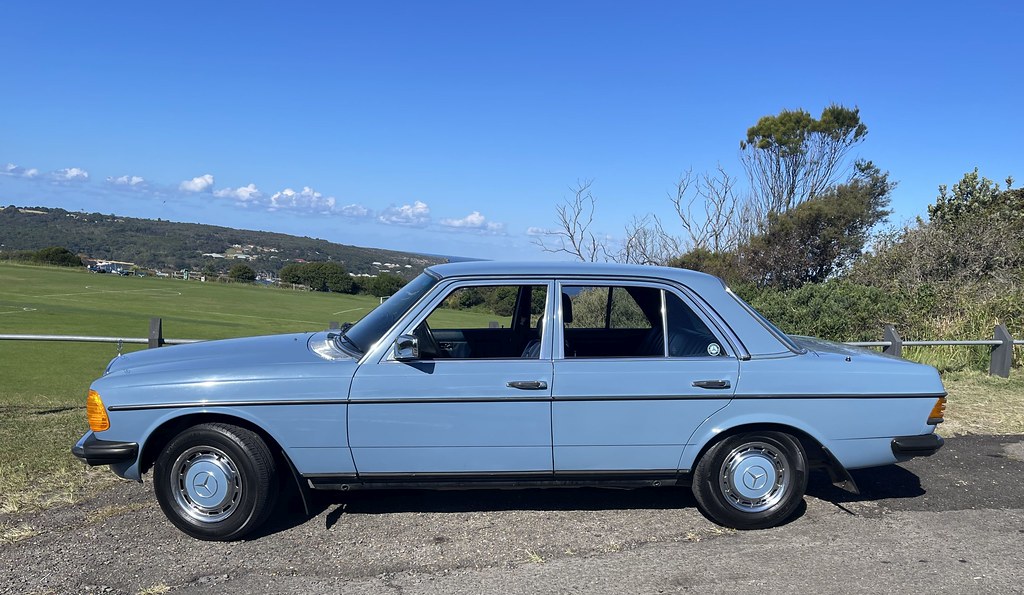
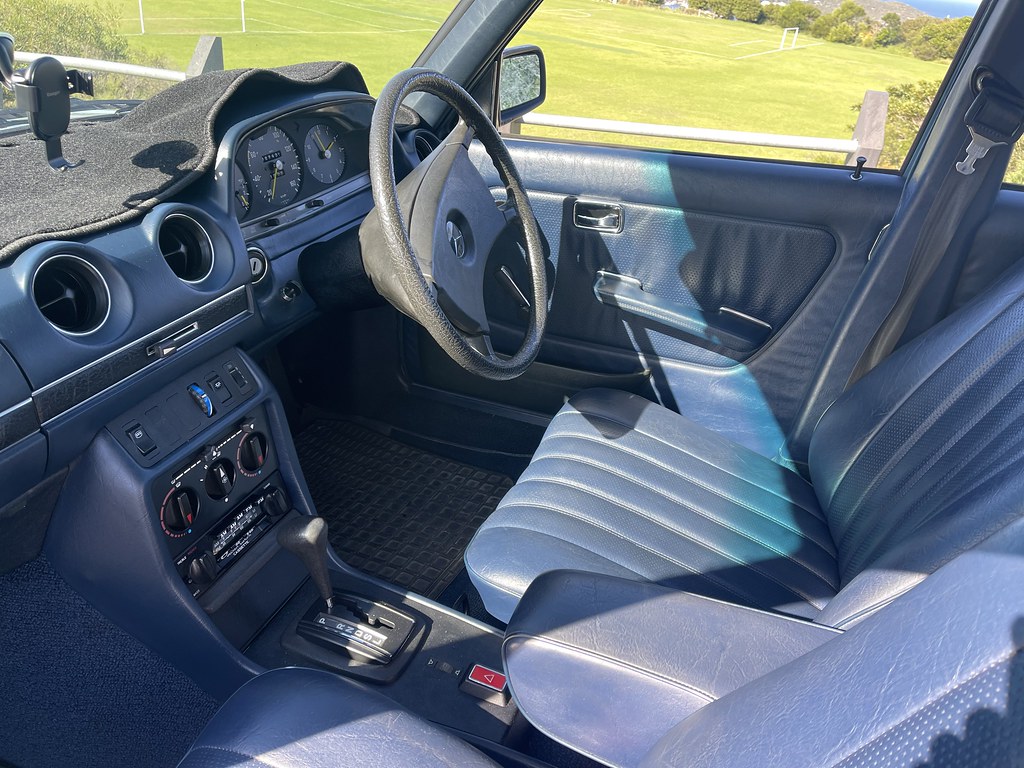
The car is a very standard Australian specification 240D. It is finished in China Blue, which I think is one of the best of the standard colours. It has blue MB-Tex interior, air conditioning, power steering and a Becker Europa Cassette. there are no other options, which is how I think a 240D should be – the appeal of the model is rugged simplicity.

The car would be a Melbourne car until my purchase in 2024, and up until then it was still fully registered on its original plate of BHB-084. It seemed to have spent a lot of its life in the Doncaster area, with at least one owner in Gippsland. I am told by a Melbourne local that a lot of fruit growing families lived in the Doncaster area back then, which would have been a natural buyer for such a car.
I bought the car from a deceased estate, and while I have the original logbook, I am very keen to learn more about the history of this car. The car is in remarkably good condition, and my assumption is that it was the pride and joy of an elderly person who was not able to drive it much in recent years. It was still kept fully registered.
Option codes
| Option Code | Meaning |
|---|---|
| 426 | 420: Power Steering 422: Automatic Transmission, Floor Shift |
| 466 | Central locking |
| 503 | Outside rear view mirror, on the left |
| 524 | Paintcoat preservation |
| 533 | Interference Suppression without radio |
| 570 | Folding armrest, front |
| 580 | Behr A/C |
| 599 | Heat insulating glass for side and rear |
| 613 | Lamp unit for LH traffic |
| 625 | Version for Australia |
| 656 | Michelin Tyres |
| 668 | 662: 10l of fuel 666: Packing VE II |
| 674 | High-capacity battery, tropical version |
| 801 | Model Year 1981 |
Why did I buy it?
This isn’t an obvious car for me to buy. On this site I have criticized models like the 420SEL and ADR 280 models for being too slow. Why would I buy an automatic 240D?
Firstly, I’ve always wanted to own a diesel Mercedes-Benz of this era. They have such a loyal fan base, and the W123 diesel is so iconic in the history of the marque. I think this is a car that every classic Mercedes-Benz enthusiast should own at least one.
Secondly, the rugged simplicity of the car appeals. One of the things I dislike about modern cars is the technology for technology’s sake. The 240D is the antithesis of this.
I’ve outlined in more detail what the car is like to drive in this article.

Sometimes you don't go looking for classic cars - they find you. While I have always wanted to try a W123 diesel, I wasn't specifically looking for one. However, when I saw this 1981 ...

With the 240D now registered and in the garage, there were a few simple jobs to undertake. The first was a set of floor mats. The original carpets were in such nice shape I ...

Yesterday I did my first proper drive in my 1981 Mercedes 240D. More information about the car can be found here. My overall impression is that the people who talk about the performance of the ...

The under bonnet insulation on my W123 240D had started to crumble on the edges. While it had only just started happening, it also appeared that the car didn't have a proper insulation mat. I'm ...

I just got my 240D back from having the motor mounts changed. When I purchased the 240D, the motor mounts were one of the few obvious things that needed attending to on the car. They ...

My 1981 Mercedes 240D still has the original Becker Europa 596 Radio. This is one of the last of the analogue radios before the cars moved to the digital radio with the Becker Grand prix ...

Since I purchased my 240D, I had planned to use 'Diesel Purge' to clean the injectors and injection pump. The car runs well, but it is a bit rough at idle and I figured this ...

Yesterday, I posted an update on my 240D showing how I had changed the petrol filters. A friend pointed out that my filter was full of algae. My 240D was from a deceased estate and ...

Over the last week or so, I've been dealing with the algae in the fuel tank of my 240D. In the last update, after changing the fuel filters, I added the Penrite Diesel Biocide. ...

Over the last few months, I have been dealing with the algae problem in my 240D. I've been quite busy with my trip to Victoria and work, so the 240D has been on the backburner. ...

Earlier this week, I removed the fuel tank from my 1981 Mercedes 240D. This was because I was unable to get the fuel strainer out from the bottom. It turned out to be not ...

In the last update, I cleaned out all the junk from my W123 fuel tank. At the time I was undecided if I should do anything about the surface rust in the bottom of the ...

In the last part, I used a fuel tank sealing product to seal my W123 fuel tank. This seemed to go quite well, but it turns out I had made a fatal mistake. Once I ...

In the last update, I ruined my W123 fuel tank. Luckily, a friend in the Mercedes Club was able to find me a very good tank as a replacement. The new tank is much better ...

Back in September, when I started to deal with the algae problem in my 240D, I noticed the car was quite hard to push. At that time I tested to see if the brakes were ...

My 1981 240D was sold new with a Becker Europa 596 Cassette. The Becker was still in the car when I purchased it, but it would not stay tuned. It would randomly drift out of ...

W123 instrument clusters are notorious for jumpy temperature and fuel gauges and mine was no different. This problem seems to impact other Benzes of the era, but is particularly pronounced in the W123. I don't ...

I recently noticed that the A/C on my 1981 240D wasn't cooling so well in heavy traffic. On closer inspection, the W123 auxiliary fan was not kicking in at all. This is supposed to kick ...

The prominent grille is one of the most obvious design features of the W123. A scruffy grille can really let down the car. On my 240D, the grille was in pretty good shape, but the ...

When I first bought my 1981 Mercedes 240D, the A/C did not work. It was apparent that the car had been siting around for a while, so it was not really surprising. What was surprising, ...

On my 1981 240D I had a problem. The sheer accelerative power of the OM616 engine was causing the Mercedes star to lie flat against the bonnet at high speeds. It is rather embarrassing to ...

Back in January when I was on my road trip to Brisbane, I noticed the glow plus relay on my 240D would randomly come on while driving. I didn't think that was a great ...

Led by the MBCACT, the state based Mercedes-Benz clubs are planning a major event for the 50th anniversary of the W123. The W123 is one of the more significant models in Mercedes-Benz history and so ...